Announcing the Iterative Mapping Grant Program – Oncology: AKT1 and EGFR proteoform analysis at no charge

Nautilus Biotechnology
October 1, 2026
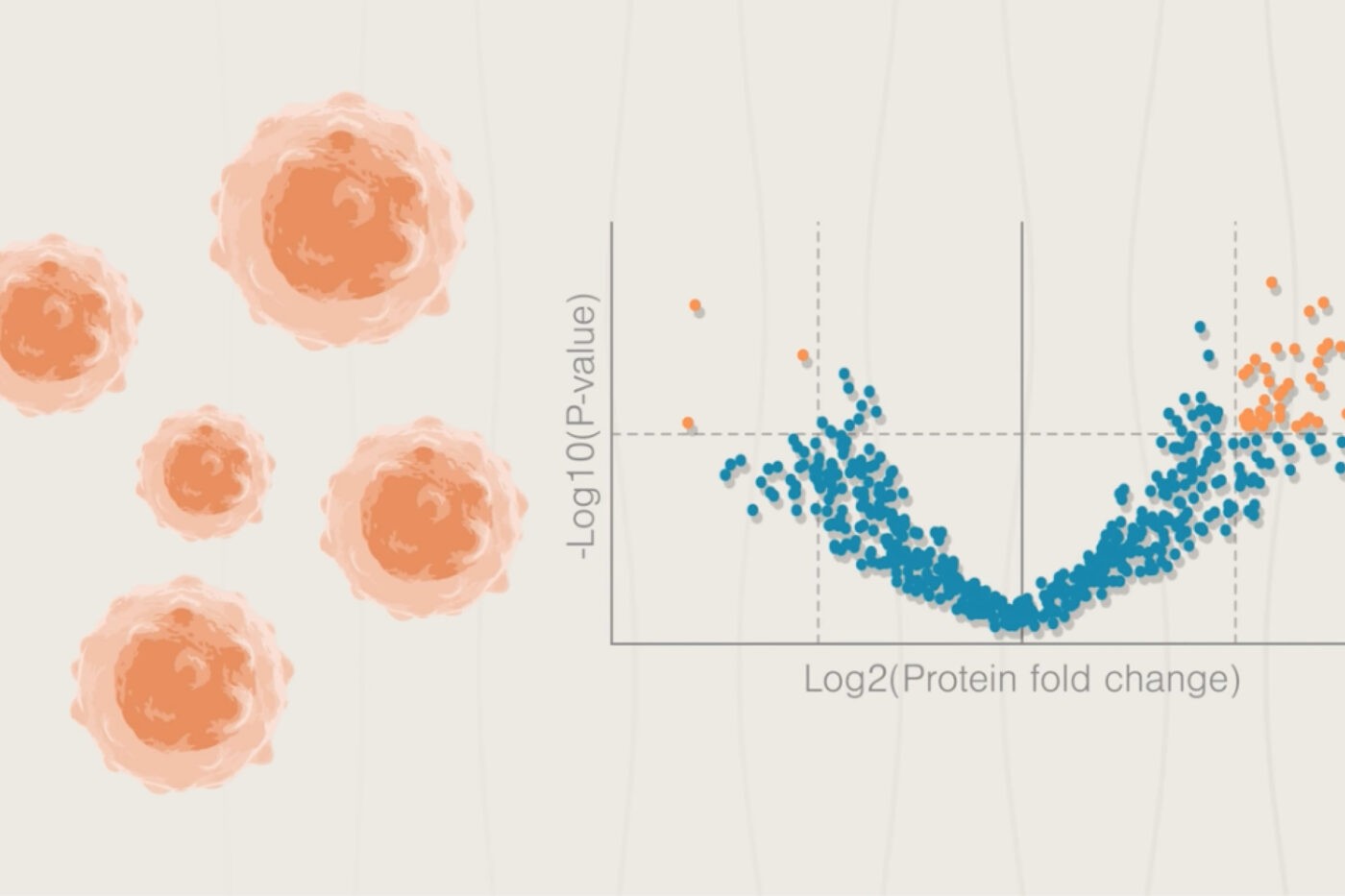
At Nautilus, we aim to enable you to reveal how proteins drive the mechanisms underlying diseases like cancer. Proteins do the work in cells, but a single protein can give rise to many proteoforms, each with its own combination of sequence variation, post-translational modifications, and any other sources of variation. Distinct proteoforms may drive processes critical to cancer. Yet no platform has been able to quantify them at scale.
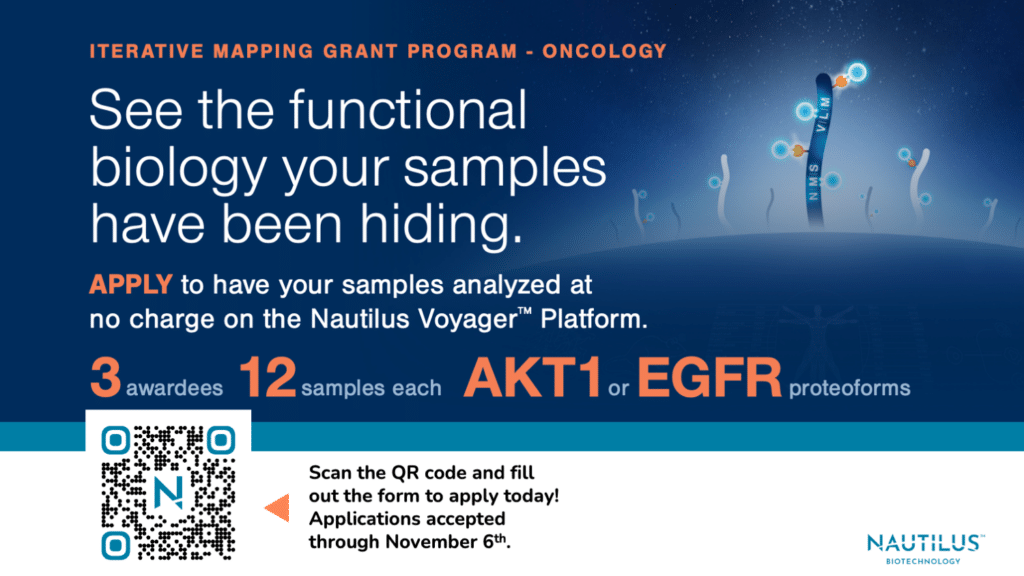
That’s why we’re launching the Iterative Mapping Grant Program – Oncology. Through it, three researchers will gain free access to the AKT1 or EGFR Proteoforms Assays currently in development for the Nautilus Voyager™ Platform.
Click here to apply to the Iterative Mapping Grant Program.
Preliminary phosphosites targeted in the AKT1 and EGFR Proteoforms Assays
The assays are in development and being designed to quantify proteoform-defining patterns of phosphorylation on intact AKT1 and EGFR molecules.
- Epitopes defining AKT1 proteoforms may include:
pS124, pS129, pT308, pT450 and pS473 - Epitopes defining EGFR proteoforms may include:
pT654, pT669, pY1045, pS1046/1047, pY1086 and pY1173
Because each molecule is measured independently, the result is a profile of which combinations are present on individual proteoforms, not just an average across the sample.
What do I get if I’m selected for an Iterative Mapping Grant?
Awardees join the Iterative Mapping Early Access Program at no charge. Each receives:
- Analysis of 12 samples on a timeline set with Nautilus.
- Experimental design support from Nautilus scientists.
- A final proteoform data report.
- Support presenting the data at a mutually agreed-upon conference.
- Assistance writing up the data for a peer-reviewed journal submission.
Example project ideas for the Iterative Mapping Grant Program – Oncology
We are most excited about proposals in the preclinical or translational research spaces, but all are welcome. Some research questions you could explore in your proposals might include (non-exhaustive):
- How do AKT1 and EGFR proteoform profiles differ between cancer subtypes?
- Do proteoform profiles track levels of cancer aggressiveness?
- Which proteoforms appear at clearly defined stages of a cancer?
- Which proteoforms are associated with particular signaling stimuli, outcomes, or oncogenic mutations?
- Which proteoforms are produced in response to cancer-associated environmental risks?
How to apply to the Iterative Mapping Grant Program – Oncology
Submit a description of a 12-sample project by November 6, 2026, using the form on the program page. Samples must be ready to ship by February 5, 2027 (see program website for sample requirements). Awardees must agree that Nautilus can announce their award and reference their work in marketing materials.
Nautilus will announce winners on or before November 20, 2026.
All analysis services provided under this program are for research use only and not for use in diagnostic procedures.
MORE ARTICLES