Be one of the first to use the Voyager Platform
Join the Early Access Program


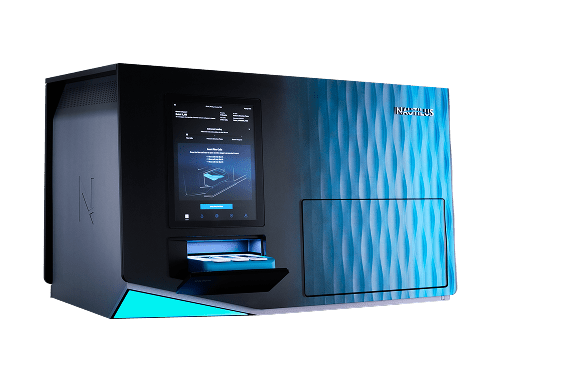
The Nautilus VoyagerTM Platform consists of integrated reagents, fluidics, imaging, and ultra-dense nano-array flow cells enabling Iterative Mapping and cloud-based analysis of single-molecule data outputs. It is designed to occupy a typical lab benchtop with standard facility requirements – no bespoke gas or fluidic connections needed.
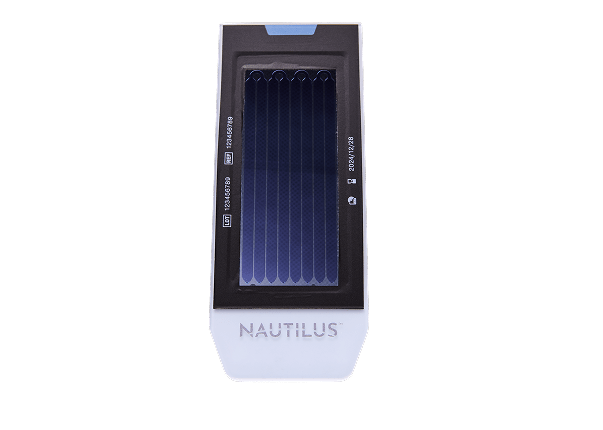
Each Voyager Instrument is designed to accommodate the analysis of up to 10 billion single protein molecules spread across three Voyager Flow Cells in a single run. These flow cells contain ultra-dense nanoarrays for protein deposition. Intact, single-molecule protein libraries are prepared in streamlined, off-platform workflows. After preparation, a sample plate is loaded onto the Instrument for automated deposition and analysis.
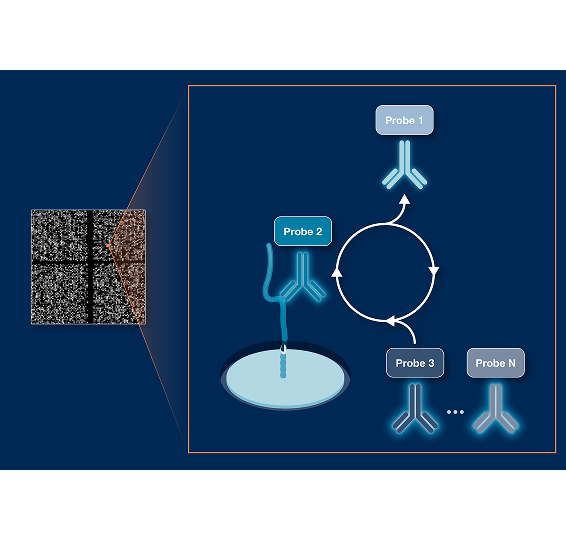
All the components of the Voyager Platform come together to enable Iterative Mapping. In this method, billions of intact protein molecules are captured and displayed on the flow cells. Then, fluorescent probes that bind features indicative of protein or proteoform identity are sequentially added to the array, and multiple probe-protein binding events are recorded for every individual protein molecule. After tens to hundreds of unique probe binding cycles, machine learning-powered algorithms convert the probe binding patterns into confident protein and proteoform identifications that are simply counted for quantification.
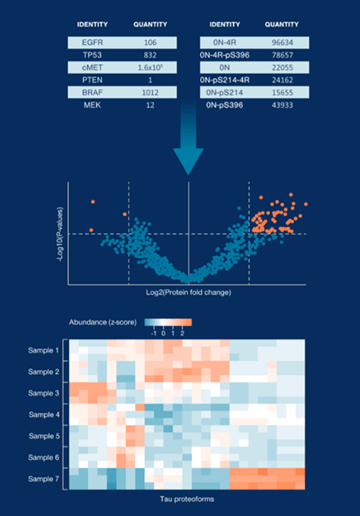
Once proteins and proteoforms have been quantified using Iterative Mapping, single-molecule counts are made available in the cloud for analysis or download as simple .CSV files. In the data analysis portal, these tables of counts can be further analyzed to uncover novel biology and visualize findings with standard volcano plots, heat maps, and upset plots.