
Discover biological
insights hidden in
your samples
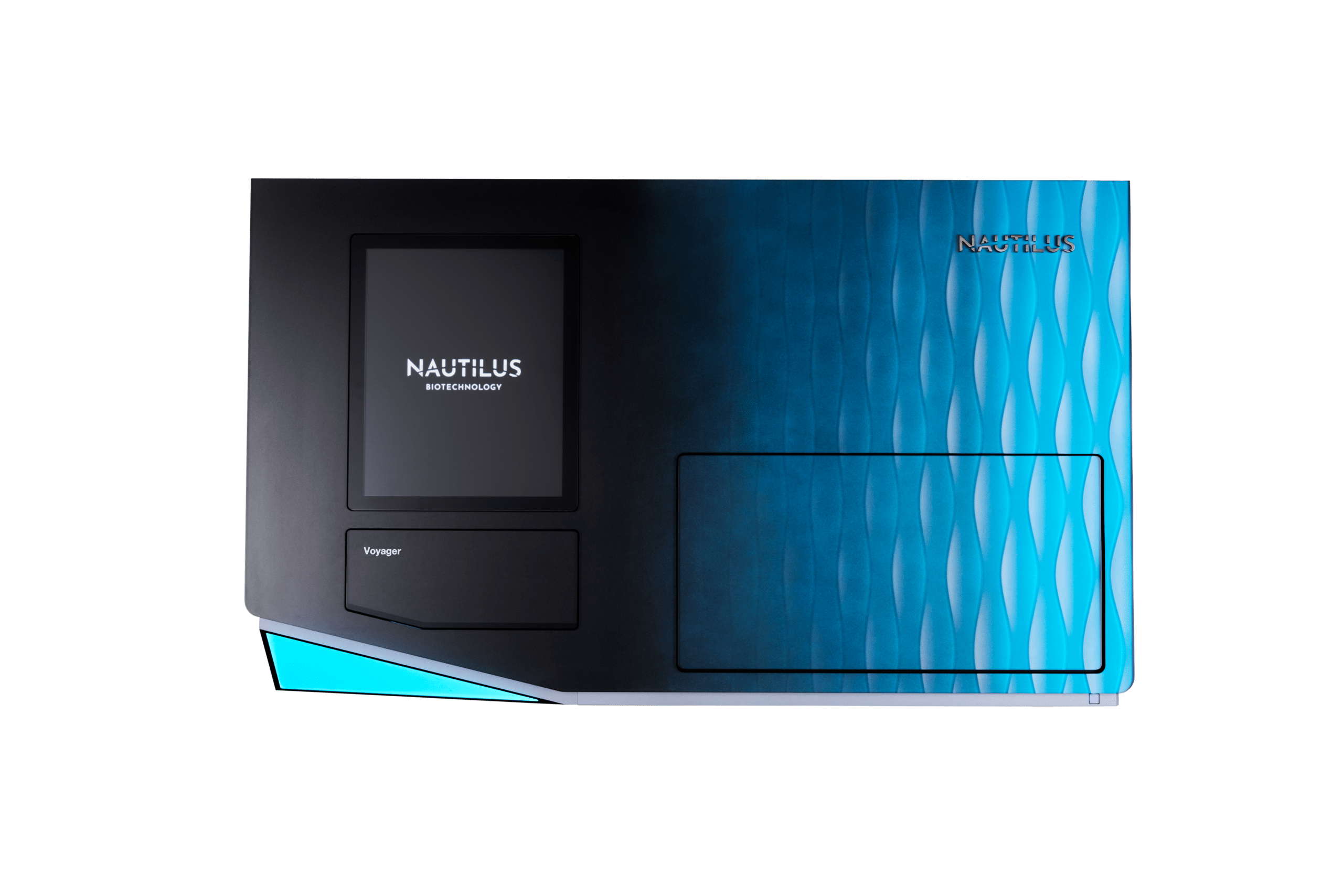
The Nautilus Voyager™ Platform is designed for accessible proteomic analysis that enables you to achieve novel insights through straightforward and reproducible single-molecule quantification of the proteins that matter to your biology of interest.
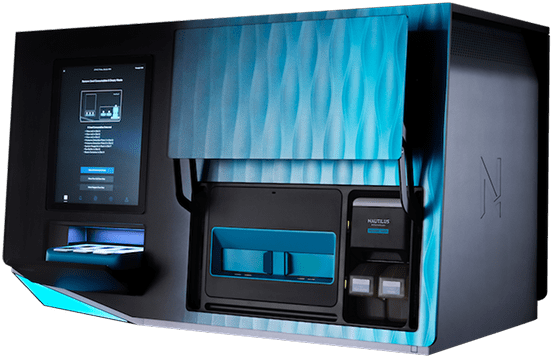
The Nautilus Voyager™ Platform
The Nautilus Voyager Platform consists of integrated reagents, fluidics, imaging, and ultra-dense nano-array flow cells enabling Iterative Mapping and cloud-based analysis of single-molecule data outputs. It is designed to occupy a typical lab benchtop with standard facility requirements – no bespoke gas or fluidic connections needed.
Current and emerging
applications of Iterative Mapping
Iterative Mapping is a foundational method with endless applications. Explore our current portfolio of applications here. If your desired application is missing, fill out the form below to let us know how you’d like to use Iterative Mapping.

Nautilus Tau Proteoforms Assay
- Quantify up to 768 distinct proteoforms across 6 human brain-derived full-length tau isoforms
- Digital counts of relative abundance normalized to total number of full-length tau counts in counts per million (cpm)
- Median CV <10% (inter-assay)
- Quantify tau proteoforms present at ≥0.1% of total tau
Nautilus Tau Proteoforms Assay
Quantify tau proteoforms at the single-molecule level and unlock deeper insights into neurobiology.

Oncology Proteoforms Assays
Assays quantifying proteoforms derived from the following proteins are currently in development:
- AKT1
- EGFR
- P53
Please fill out the form on the Iterative Mapping Early Access Program webpage to be one of the first to incorporate these assays into your workflows.
Oncology Proteoforms Assays
Quantify proteoforms derived from proteins known to be critical to cancer.
Join the Iterative Mapping
Early Access Program

Interested in using Iterative Mapping
for a different application?
Tell us about it!


Discover what other researchers are
saying about the Nautilus Voyager™ Platform
"Bottom-up proteomics established much of what we know about the proteome by cutting proteins to pieces and reassembling the information. The introduction of Iterative Mapping on the Nautilus Voyager Platform marks the opening of a new era: one where intact, full-length proteins come into the light, and the combinatorial modification landscapes that drive biology are finally within reach."

Don Kirkpatrick, Ph.D.,
Proteomics Scientist and
Biotech Executive
“Understanding which forms of tau drive neurodegeneration has been one of the central unanswered questions in our field. Measuring combinatorial modifications on individual, full-length tau molecules at this scale opens a new path to accelerating the search for earlier diagnostics and more precise therapies that patients urgently need.”

Joel Blanchard, Ph.D.,
Associate Professor, Ichan School of Medicine
at Mount Sinai
"With Iterative Mapping, we now have the unprecedented ability to analyze proteins at the level of distinct proteoforms and to see which variants drive disease. What surprised us most is how differently tau behaves across the model systems our field relies on every day. That has immediate consequences for how biomarker studies are designed and how drug programs choose their models."

Taylor Bertucci, Ph.D.
Principal Investigator
Neural Stem Cell Institute