Advancing the identification of biomarkers and drug targets as part of the ARPA-H-funded SEEDS Consortium

Nautilus Biotechnology
October 27, 2026
The Advanced Research Projects Agency for Health (ARPA-H) recently announced an award of up to $51.7 million to the SEEDS Consortium, co-led by the Buck Institute for Research on Aging and Georgetown University. As a member of the consortium, Nautilus expects to receive up to $6 million for our work under the program. This four-year effort aims to predict harmful changes in intrinsically disordered proteins (IDPs). These proteins have dynamic, context-dependent structures. While they carry out many useful functions, it is difficult to predict when they will adopt disease-causing shapes.
As part of the consortium, Nautilus plans to deploy the Voyager™ Platform to examine links between proteoforms, IDP structures, and disease states. The consortium will then use these links, along with many other IDP analyses, to develop models that predict IDP behavior. Ultimately, the consortium hopes its work will lead to the identification of new IDP-based biomarkers and drug targets.
We are thrilled to be part of the SEEDS Consortium and believe its work will vastly enhance our collective ability to improve lives around the world.
Read on to learn more about IDPs and how proteoform analysis can advance their study. If you’d like to use our Iterative Mapping method to analyze proteoforms in your work, please join our Early Access Program.
Read our recent press release about our involvement in the SEEDS Consortium.
What are intrinsically disordered proteins (IDPs)?
In introductory biology, we’re taught that a protein’s amino acid sequence determines its three-dimensional structure. While this is true for many proteins, as many as half of human proteins may be “intrinsically disordered” or contain intrinsically disordered regions. That is, they have portions with highly dynamic structures that can assume many different shapes in response to their environment.
It’s not that these proteins never adopt predictable structures; they just have regions that adapt to their surroundings. This flexibility lets IDPs take on a variety of context-dependent structures and functions. For example, many transcription factors, such as the tumor suppressor p53, are IDPs. However, this flexibility has a downside: many IDPs, such as tau, can adopt structures that are detrimental to health, even if their other structures carry out critical healthy functions.
Why do we need new tools to assess IDP structure?
The tools developed over the last century to analyze protein structure work well on “globular proteins,” proteins with consistent, relatively stable structures. The data generated by these tools can then be used to train models that do a great job of predicting the structures of similarly stable proteins. Comparable data simply don’t exist for IDPs. Thus, the tools of the past falter when it comes to analyzing and predicting IDP structures. This makes it difficult to understand IDP function and predict when IDPs will adopt detrimental forms.
How can proteoform analysis on the Nautilus Voyager™ Platform expand our understanding of IDP structure?
Proteoforms are the distinct versions of proteins found in cells. They are environment-dependent and defined by combinations of genetic variation, alternative splicing, post-translational modifications, and other sources of variation. These determinants of proteoform identity potentially influence the structures taken on by individual protein molecules, even IDP molecules (see Figure 1). Thus, quantifying proteoforms in health and disease may help us understand and predict IDP behavior.
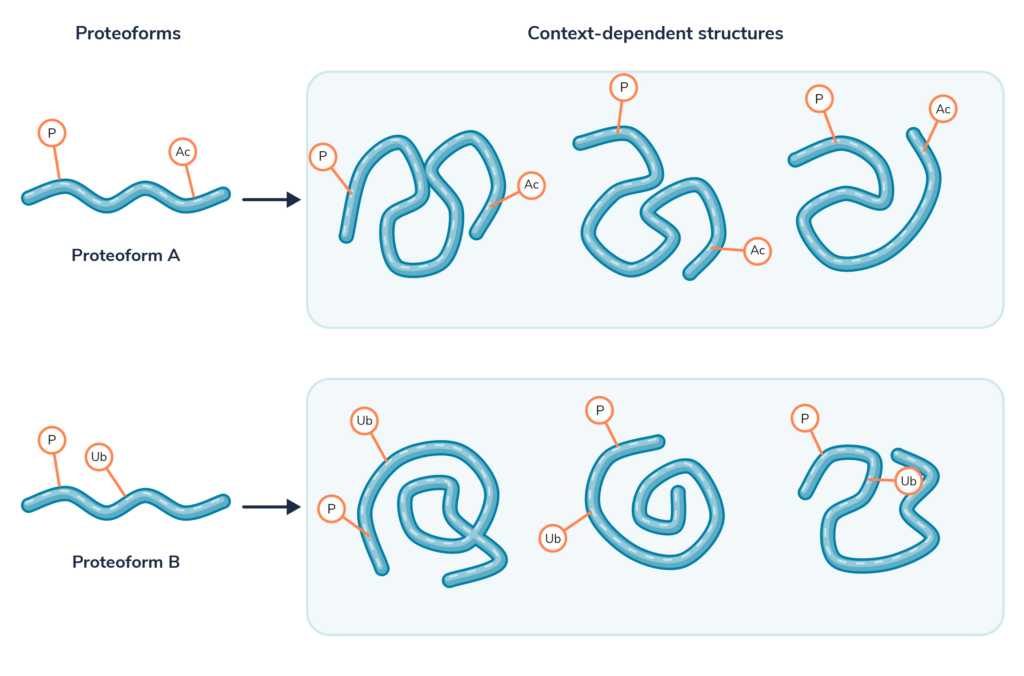
Figure 1: Different proteoforms of the same protein, defined here by different combinations of modifications (P, phosphorylation; Ac, acetylation; Ub, ubiquitination), can each adopt their own set of context-dependent structures.
The Nautilus Voyager Platform is uniquely designed to identify and quantify proteoforms through its single-molecule analysis capabilities. The platform is designed to report the determinants of proteoform identity for every targeted protein molecule in a sample and then quantify proteoforms by counting those molecules with the same determinants. Using the platform, researchers may be able to determine which IDP proteoforms are associated with disease. These proteoforms may serve as new biomarkers or therapeutic targets. Thus, proteoform-powered IDP analysis may help researchers develop treatments for currently intractable diseases.
Supporting the SEEDS Consortium enhances Nautilus’ ability to achieve its mission
We are beyond grateful to be part of the SEEDS Consortium. From Nautilus’ founding, we’ve set out to accelerate advances that will have a positive impact on human health. That goal is crystallized in our mission, “to positively impact the health of millions around the world.” By filling a major gap in biomedical research, SEEDS has the potential to enable incredibly impactful new biomarkers, diagnostics, and drugs. We cannot wait to get started.
MORE ARTICLES