Will proteoforms change our understanding of biology? Highlights from our HUPO 2026 panel

Nautilus Biotechnology
October 8, 2026

Why proteoforms, and why now
We often talk about the human proteome as roughly 20,000 proteins, one for each protein-coding gene. But biology works with far more variety than that. Alternative splicing expands those genes into more than 70,000 protein isoforms, and post-translational modifications (PTMs) such as phosphorylation, acetylation, and methylation expand them again into an estimated 6,000,000 or more distinct proteoforms (Ponomarenko et al., 20216).
Fill out this form to access the panel recording
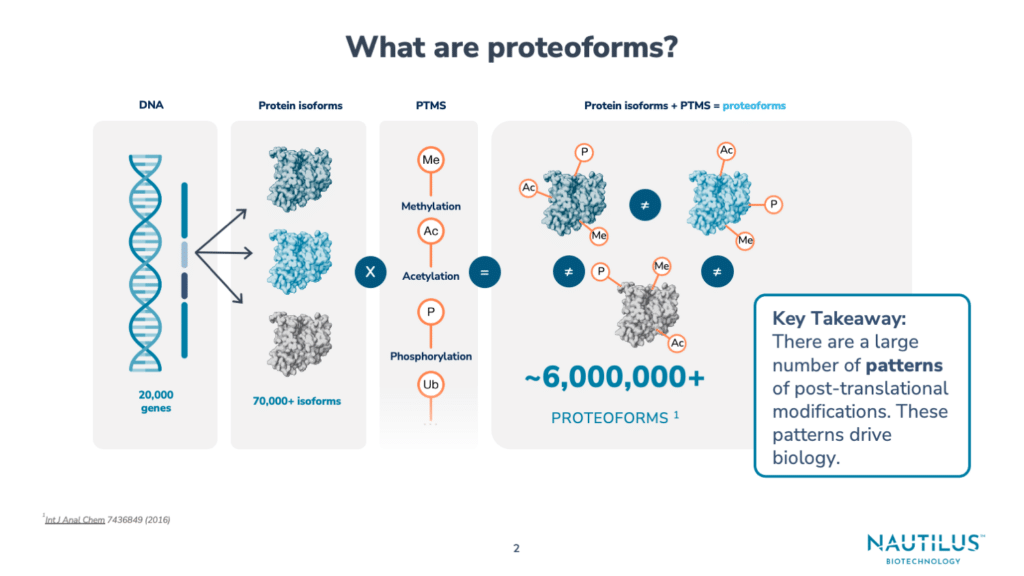
That complexity matters. Different proteoforms of the same protein can have different molecular functions, and a biological system’s overall proteoform profile likely determines its phenotype. Two samples can contain the same amount of a given protein and still behave very differently, depending on which proteoforms are present. For example, work from the Kelleher and Ladner labs at Northwestern University used top-down mass spectrometry to show that distinct plasma proteoform profiles track with liver cirrhosis severity, and that proteoforms of the same protein do not always share the same disease associations (Forte et al., 2024).
Until recently, studying proteoforms at scale has been difficult. That is starting to change with technologies like the Nautilus Voyager™ Platform, and recent advances raise a big question: will proteoforms change our understanding of biology?
Meet our HUPO 2026 panel of proteoform experts
At HUPO 2026, the Human Proteome Organization’s annual World Congress, Nautilus hosted a lunch seminar to tackle that question with three leaders in proteomics:
- Birgit Schilling, PhD, Buck Institute for Research on Aging, whose lab uses advanced mass spectrometry to study the molecular mechanisms of aging.
- Jochen Schwenk, PhD, KTH Royal Institute of Technology, whose lab develops approaches for analyzing proteins in bodily fluids as biomarkers of health and disease.
- Bernd Wollscheid, PhD, ETH Zürich, whose lab develops chemoproteomic and mass spectrometry technologies to read the cell surfaceome at nanoscale resolution.
The discussion was moderated by Sheri Wilcox, PhD, Nautilus VP of Scientific Engagement. Questions came from the Nautilus team, the broader proteomics community online, visitors to our booth, and the live audience.
Each panelist came from a different research perspective, but they shared a common starting assumption. As Bernd put it:
“We operate under the assumption, like everybody else, that proteins don’t exist, but proteoforms do.”
Want to hear the whole conversation? Fill out this form to access the full panel recording.
Five big questions from the panel
1. Where is it critical to study proteoforms, and where is it less critical?
The short answer from the panel: it’s critical almost everywhere. Birgit argued that proteoforms influence function, protein-protein interactions, and nearly everything that makes a cell work, so no protein is truly captured by a single accession number. She highlighted precision medicine as a place where knowing a patient’s proteoform portfolio for a disease-relevant protein could be especially valuable.
Bernd pointed to therapeutic development. In his lab’s newer work on antibody-drug conjugates, bispecifics, and other antibodies, clearance depends on post- and co-translational modifications, and removing a single fucose residue from a glycan can dramatically change killing capacity. For that field, he said, proteoform-level information is required. Jochen added that because proteins are the leading class of drug targets, proteoform resolution will be key to understanding how treatments modulate protein function. Furthermore, proteoform analyses may enable the development of blood or urine biomarkers that show whether a drug is working in a patient.
2. What is the best evidence that proteoforms unlock biological function, and what do we still need?
Jochen said the strongest evidence today is prior knowledge: well-characterized targets where a specific phosphorylation or interaction is known to affect function or bioavailability. Those cases are a practical starting point and easier to justify to funders and journals. Longer term, he suggested the field may borrow from genomics by hunting for rare proteoforms and eventually building something like a polyproteoform risk score to refine diagnosis and treatment decisions.
Birgit noted that clinical diagnostics have hinted at this for decades. Prostate-specific antigen (PSA) tests, for example, largely measure the protein itself, even though disease-associated PSA forms differ in glycosylation. Proteoform-aware biomarkers could improve specificity and help patients avoid unnecessary biopsies.
Bernd described an experiment that was eye-opening for his team. Multiple antibody clones against the same cell-surface drug target, CD20, all produced the expected flow cytometry shift. But proximity-labeling experiments revealed that the targeted molecules sat in different protein communities. In other words, there were coexisting proteoform-specific complexes with potentially divergent functions.
From the panelists’ perspective, there is ample evidence that we need to study proteoforms. Now, we must dig deeper to understand how proteoforms interact and to determine what specific molecular functions they carry out.
3. How do we make sense of the vast proteoform landscape without getting lost?
The panel agreed that we do not need to measure everything. Bernd urged the field to divide and conquer the space by starting with the right biological question and focusing on relevant subsets of proteoforms, perturbation experiments, and proteoform-specific complexes that can be tracked over time. He cited targeted efforts such as the Nautilus Tau Proteoforms Assay and the AKT1 and EGFR proteoform assays now in development as examples of measuring the right things rather than everything.
Birgit encouraged researchers not to be intimidated. Proteomics already deals with vast datasets, such as studies that report tens of thousands of phosphosites, and the same approach applies: bring a hypothesis, partner with biological experts, and test what looks interesting.
Jochen cautioned against simply publishing ever-longer lists of identified proteoforms. He proposed agreeing on a set of reference, or flagpole, proteoforms to anchor interpretation, along with strong data support to address software errors and sample-prep artifacts. He also reminded the audience to be ready for surprises: some proteoform differences may turn out to have no functional consequence because the rest of the system has adapted around them. Bernd added that validation, not measurement, is currently the bigger bottleneck.
4. How should structure–function studies evolve when a protein exists as many proteoforms?
Is the structure of a single recombinant, canonical protein giving us an incomplete or even misleading picture? Jochen framed it as a starting point: every first structure is eventually refined, and the field should treat today’s structures as knowledge that will be replaced as measurement improves. Birgit agreed that a recombinant structure is a good start but noted that many proteins have unstructured domains, and knowing which proteoforms exist could help computational methods propose better structures over time.
Bernd described his lab’s work on the hepatitis B virus protein HBx, an intrinsically disordered, multitasking protein that adopts different structures and binding partners depending on its phosphorylation. Understanding it will require synthesizing specific proteoforms cleanly, which means closer collaboration with chemists. Jochen summed up the broader point: proteins are social molecules that never act in isolation, so interactions and context matter as much as structure.
5. How do we know that a proteoform is active?
Bernd acknowledged that this is genuinely hard. For some enzymes, phosphorylation-driven structural changes offer clues, but he suggested shifting focus to how proteoforms assemble into complexes. He pointed to work separating distinct forms of the transcription factor YAP1 to reveal different functions as the kind of approach the field needs more of.
Jochen asked what active really means: performing its predicted function, or doing what an experimenter wants it to do? In circulation, transient binding between proteins affects bioavailability, so activity may itself be dynamic. Birgit suggested pairing proteoform measurements with orthogonal readouts, such as metabolomics or bioenergetic assays, guided by a clear hypothesis.
Overall, the definition of activity depends on the lens. A proteoform that is “inactive” from one perspective, say in terms of interacting with protein X, may be “active” from another perspective, say by phosphorylating protein Y.
Three key takeaways
So, will proteoforms change our understanding of biology? The panel’s answer was an optimistic yes, with important caveats about how the field gets there.
- Proteoforms matter nearly everywhere, with the most immediate payoff in medicine. From precision diagnostics and more specific biomarkers to antibody therapeutics whose performance hinges on a single glycan, the panelists saw proteoform-level resolution as essential wherever function and treatment response are on the line.
- Start with the right biological question, not the whole landscape. The proteoform space is large but bounded. Focusing on relevant proteins, perturbations, and reference proteoforms, and pairing measurements with clear hypotheses, will turn complexity into insight rather than ever-longer lists.
- Measurement is the beginning, not the end. The next frontier is functional validation: resolving proteoform-specific complexes, synthesizing defined proteoforms with help from chemists, combining proteoform data with orthogonal assays like metabolomics, and eventually tracking proteoform dynamics over time.
Birgit captured the spirit of the discussion when she encouraged researchers to see opportunity in the complexity:
“Just because it’s complex, one shouldn’t be afraid of it.”
Explore AKT1 and EGFR proteoforms with Nautilus
Ready to put these ideas into practice? Nautilus is now accepting applications for its next Iterative Mapping Grant Program. Selected researchers will have AKT1 or EGFR proteoforms measured in 12 of their samples at no cost using our preliminary oncology proteoforms assays on the Nautilus Voyager™ Platform. The Voyager uses Iterative Mapping to provide high-resolution views of billions of single, intact protein molecules and their biology-driving patterns of modification.
Apply to the Iterative Mapping Grant Program
Working in neuroscience? The Nautilus Tau Proteoforms Assay, which can quantify up to 768 tau proteoform groups, is available today through the Iterative Mapping Early Access Program.
Watch the full panel
This recap only scratches the surface. Hear every answer, the audience Q&A, and the panelists’ final thoughts on measuring proteoform dynamics in the complete recording.
MORE ARTICLES