Meet the July 2026 Iterative Mapping Grant Program awardees

Nautilus Biotechnology
August 20, 2026
We launched the Iterative Mapping Grant Program in early July to provide a select group of researchers access to the Iterative Mapping Early Access Program at no charge. Through the program, these researchers will analyze 12 samples with the Nautilus Tau Proteoforms Assay capable of quantifying up to 768 tau proteoforms with single-molecule resolution.
We received many excellent applications covering an impressive diversity of projects focused on tau’s functional roles in a wide variety of neurological conditions and are proud to announce our three awardees. We provide brief descriptions of their projects here, and you can find more thorough descriptions later in this post.
Congratulations to the awardees:
 |
Jessica Lagerwall – PhD Student in the Mertens Lab at the University of California San Diego Jessica will use the Nautilus Tau Proteoforms Assay to assess whether antisense oligonucleotide (ASO) treatment of induced neurons (iNs) from frontotemporal dementia patients corrects disease-associated proteoform signatures. |
 |
Adrian Oblak, PhD – Associate Professor at the Indiana University School of Medicine Adrian will use the Nautilus Tau Proteoforms Assay to quantify tau proteoforms associated with frontotemporal dementia-causative alleles in the MAPT-GR mouse model, which expresses the full human tau locus. |
 |
Ethan Smith, PhD – Postdoctoral Associate in the Tsai Lab at MIT Ethan will use the Nautilus Tau Proteoforms Assay to characterize the tau proteoform signature of the aggregation-primed state in iPSC-derived brain organoids. |
Notably, all three projects converge on a shared question from different directions: whether causally diverse neurodegenerative conditions share a common tau proteoform signature or mechanism-specific ones. Adrian’s work tests this in vivo in humanized mice, Ethan’s in aged brain organoids primed for aggregation, and Jessica’s in patient-derived neurons with the added question of whether a therapeutic can reverse the neurodegenerative signature.
More details on the winning Iterative Mapping Grant Program proposals
Jessica Lagerwall – Using ASOs to correct tau proteoform profiles in frontotemporal dementia (FTD)
The Mertens Lab has validated antisense oligonucleotides (ASOs) that shift MAPT splicing toward the 3R isoform, restoring a healthier 3R:4R balance. Because 4R tau is more prone to aggregation and hyperphosphorylation in many tauopathies, reducing its relative abundance may limit the accumulation of pathogenic, hyperphosphorylated tau isoforms.
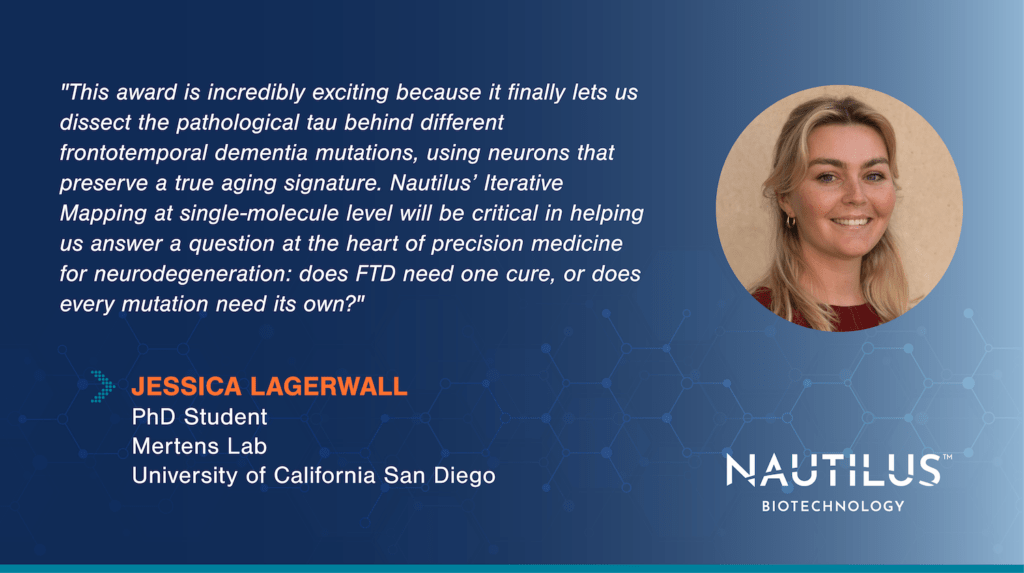
Jessica plans to use these ASOs to treat induced neurons (iNs) from patients with distinct FTD-causing tau mutations. These iNs are created using a reprogramming method that conserves the age-associated epigenetic and molecular signatures that are otherwise erased during iPSC-derived neuron reprogramming. This conservation enables the iNs to express a wide array of tau isoforms including 4R tau. Jessica will use the Nautilus Tau Proteoforms Assay to compare tau proteoforms across ASO-treated FTD patient iNs, untreated FTD patient iNs, and healthy donor controls. This will reveal whether distinct FTD-causing variants drive distinct or similar proteoform profiles, and whether ASO treatment shifts disease profiles toward the healthy signature.
This work will link specific FTD-causing variants to specific tau proteoform profiles and assess whether a promising therapeutic modality can correct those profiles. Ultimately, it may help researchers better target tau with novel therapeutics.
Jessica on why she’s excited to participate in the Iterative Mapping Grant Program:
Adrian Oblak, PhD – Quantifying tau proteoforms associated with frontotemporal dementia-causative alleles in the MAPT-GR mouse model
Wild type mice do not express all six of the CNS tau isoforms found in humans. This makes it difficult to effectively model tauopathy in them. The MAPT gene-replacement (MAPT-GR) mouse model generated in collaboration with Mike Koob, PhD and the IU/JAX/PITT MODEL-AD consortium has had its entire Mapt locus replaced with the full-length human MAPT gene. It thereby expresses all six human CNS tau isoforms, making it an excellent model for studying tauopathies.
FTD is a neurodegenerative disease that can be caused by a variety of MAPT mutations. These mutations all cause tau aggregation, but some do so by causing splicing imbalances and shifting the tau population toward 4R isoforms while others cause aggregation without altering splicing.
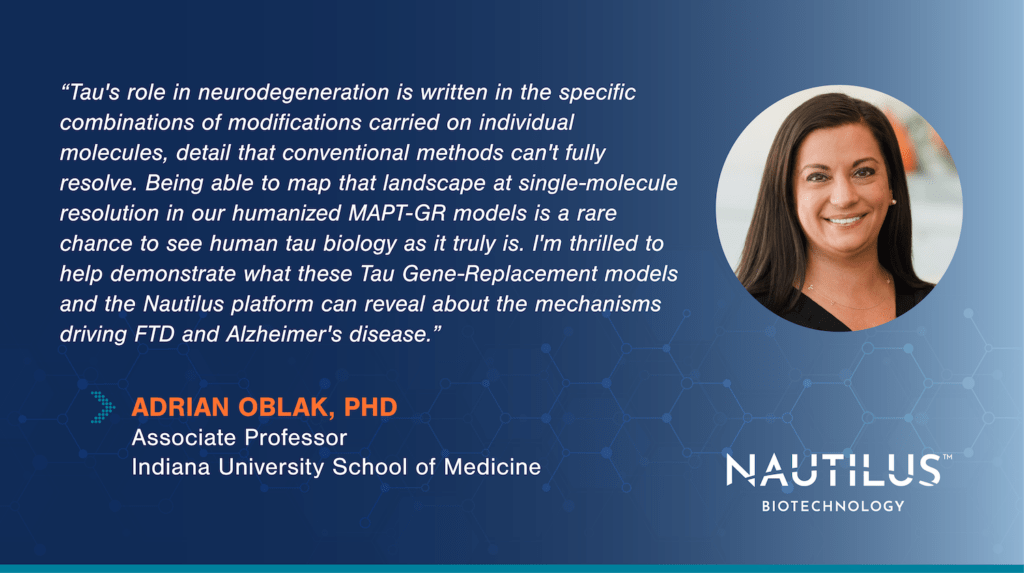
Adrian will use the Nautilus Tau Proteoforms Assay to assess how a variety of FTD mutations alter tau isoform ratios and phosphorylation patterns at the proteoform level in the MAPT-GR model. She will further determine which proteoforms are shared or distinct across the FTD alleles.
This work will create a series of proteoform-benchmarked humanized reference models that can be used in a wide variety of studies of FTD. The work may also identify which tau proteoforms actually drive disease.
Adrian on why she’s excited to participate in the Iterative Mapping Grant Program:
Ethan Smith, PhD – Analyzing tau proteoforms that are primed for aggregation
Researchers know that tau becomes gradually more modified as neurodegenerative conditions like Alzheimer’s disease (AD) progress. Furthermore, it’s known that tau aggregates in these conditions and that the tau molecules found in these aggregates are highly modified. Yet, it is not clear which forms of tau seed aggregation, and which are prone to aggregation.
Ethan has created iPSC-derived brain organoids with a variety of gene variants known to drive or confer risk for neurodegenerative conditions. He’s observed that these organoids display expected increases in tau modification and changes to tau splicing as they age. However, he does not observe aggregation.
Ethan will use the Nautilus Tau Proteoforms Assay to define which tau proteoforms make up the aggregation-primed state in these organoids. He’ll then expose a fraction of the organoids to AD-derived tau seeds to push the primed tau molecules toward aggregation, revealing which proteoforms mark that transition. Ultimately, this work aims to concretely identify aggregation-primed tau proteoforms that may become early disease biomarkers and drug targets whose clearance may one day prevent the development of neurodegenerative disease.
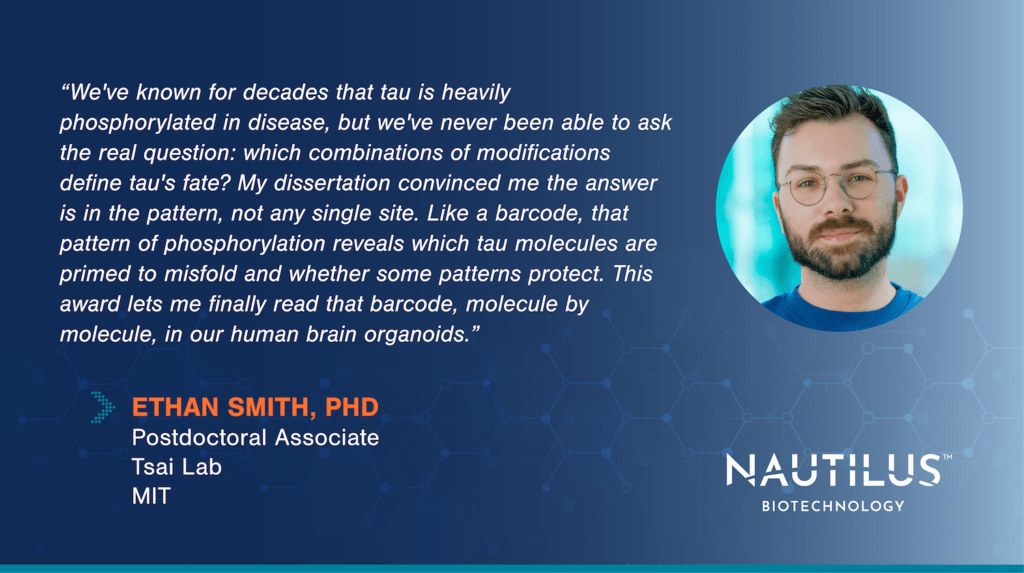
Ethan on why he’s excited to participate in the Iterative Mapping Grant Program:
Look out for future Iterative Mapping Grant Programs
Congratulations again to Jessica, Adrian, and Ethan! If you didn’t get a chance to participate in the Iterative Mapping Grant Program this time around, be sure to keep an eye on the Nautilus website. We’ll announce new programs periodically and look forward to engaging with you as we roll out capabilities for the Nautilus Voyager™ Platform and its underlying Iterative Mapping methodology.
If you’d like to start using the Nautilus Tau Proteoforms Assay in your own work now, please submit a project proposal through the form on the Iterative Mapping Early Access Program webpage.
MORE ARTICLES