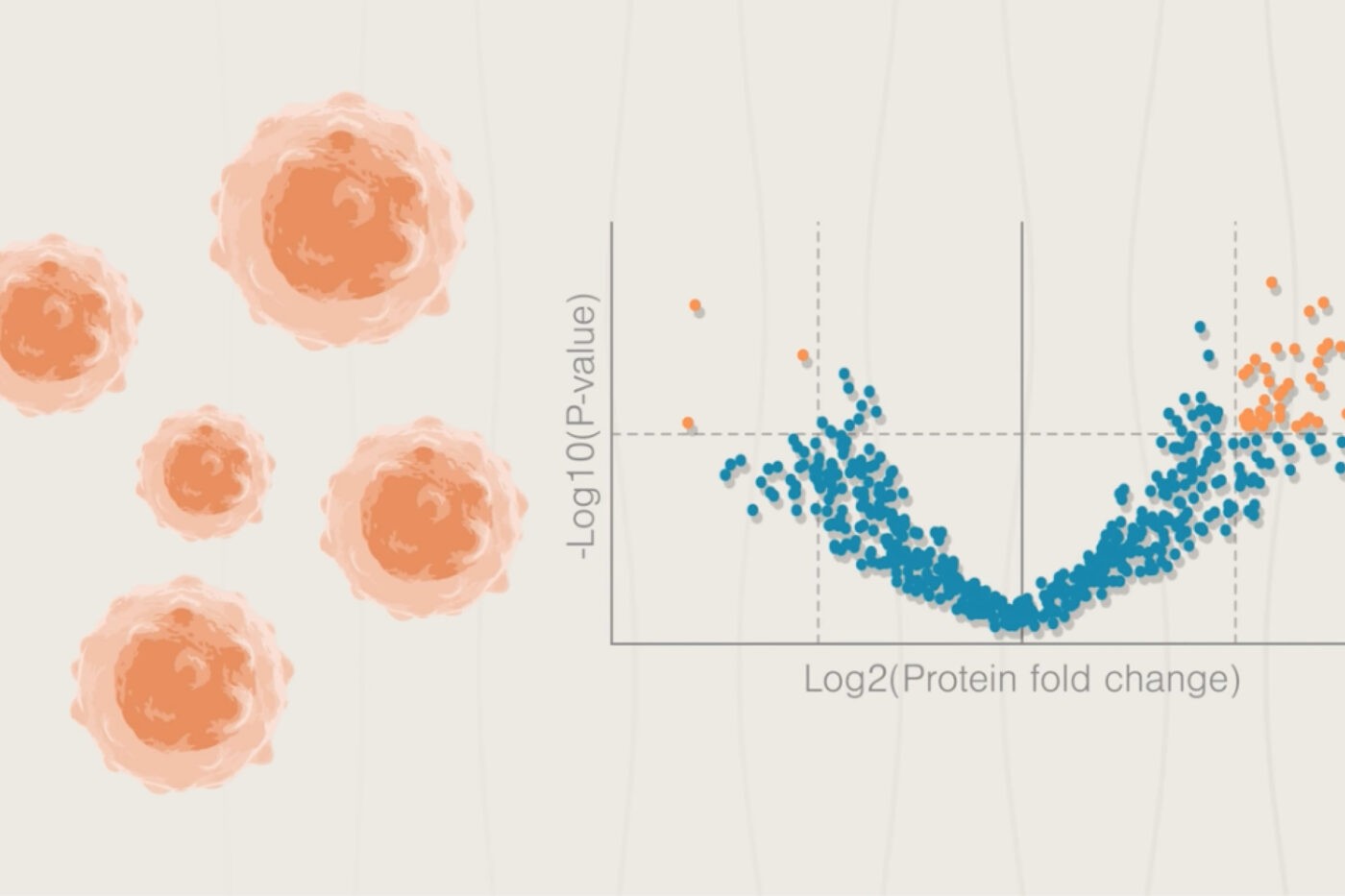

Supported by Iterative Mapping, the Nautilus Voyager™ Platform is designed to be highly adaptable and to enable scalable single-molecule analysis of proteomes and proteoforms. The biology research community is full of extremely creative scientists who we hope will deploy the platform in incredibly impactful ways that we cannot foresee, but we cover some potential initial use cases here.
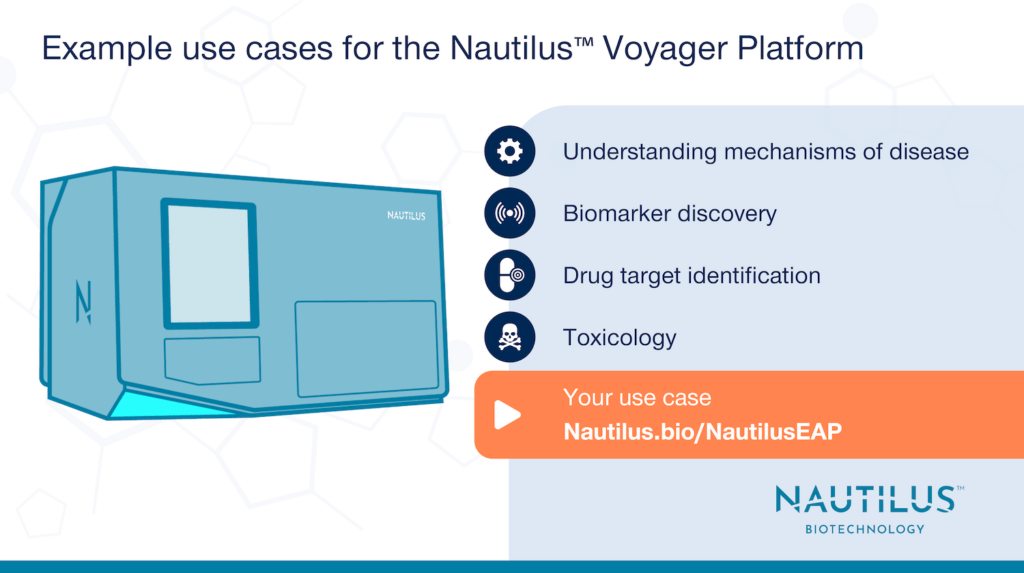
Understanding mechanisms of disease
Proteins largely control and drive biological functions and diseases. By using the Nautilus Voyager™ Platform to comprehensively map both dramatic and nuanced changes to the proteome, researchers may be able to identify the pathway fluctuations and deviations that drive disease. They may also determine how the composition of individual protein molecules change to disrupt these pathways at the molecular level. In this way, the Nautilus Voyager™ Platform may provide researchers with functional clarity into the molecular mechanisms of disease. See Joly et al., 2025 for examples of tau proteoforms that the Nautilus Voyager Platform can already begin to associate with Alzheimer’s disease and related dementias.
Biomarker discovery
Effective biomarkers accurately measure proteins that reliably change during disease and thereby mark the presence, absence, or potential for disease. The Nautilus Voyager™ Platform is designed to reveal biomarkers that have traditionally been difficult to identify. These may include:
- Biomarkers derived from the measurement of many proteins simultaneously. It may be difficult to reliably measure many proteins at once on other proteomics platforms, but Iterative Mapping is designed to unlock the ability to comprehensively measure nearly every protein in the proteome simultaneously and independently.
- Biomarkers derived from the measurement of low abundance proteins. Given the single-molecule nature of Iterative Mapping, the Nautilus Voyager Platform is designed to be uniquely suited to measuring nuanced changes in low abundance proteins.
- Biomarkers derived from the measurement of proteoforms. Few technologies can detect or quantify proteoforms today, but there may be proteoforms whose presence, high abundance, or depletion are uniquely associated with disease. Proteoforms are a largely untapped area for biomarker development that the Nautilus Voyager Platform is uniquely designed to explore.
Learn more about biomarker discovery
Drug target identification
For the same reasons that the Nautilus Voyager™ Platform may identify new biomarkers, it is also designed to be uniquely suited to identify previously hidden drug targets composed of multiple proteins, proteins with nuanced abundance changes during disease, low abundance proteins, and proteoforms. Furthermore, longitudinal studies enabled by the platform’s accessibility may identify proteome and proteoform profiles indicative of the early stages of disease that drug developers might target with early interventions.
For example, a researcher may use the Nautilus Voyager Platform to identify proteoforms that fail to cause disease themselves, but which are precursors to disease-causing proteoforms. By designing drugs that eliminate these precursors or prevent their modification into more problematic proteoforms, researchers may be able to prevent the severe impacts from a disease from arising. See Joly et al., 2025 for an early example of the platform’s ability to identify potential precursors to a highly modified tau proteoform in Alzheimer’s disease.
Learn more about using proteomics to improve the drug development process
Toxicology
Many drugs seem promising in models but fail in clinical trials due to toxic effects in patients. The Nautilus Voyager™ Platform may enable researchers to detect toxic impacts of drugs before they manifest in the clinic in a variety of ways including:
- Single-molecule proteomic analyses on the Nautilus Voyager Platform may reveal nuanced changes indicative of toxicity in pre-clinical models that are missed by traditional proteomics platforms.
- Broadscale proteomic and targeted proteoform studies on the Nautilus Voyager Platform may reveal which disease models best recapitulate the important molecular characteristics of a disease. By using these superior models for pre-clinical studies, researchers may be able to identify signals of toxicity before they ever enter patients.
- Single-molecule proteomic analyses on the Nautilus Voyager Platform may identify signs of toxicity in patients before they lead to adverse outcomes. Physicians may then be able to mitigate the toxicity before it becomes a problem or end an experimental treatment before a patient is harmed.
Use the Nautilus Voyager™ Platform in your research
The general use cases described above are just some of the many ways you can apply the Nautilus Voyager™ Platform in your research. If you’re ready to use the platform, please submit a project as part of our Iterative Mapping Early Access Program and you can be one of the first to bring this unique single-molecule proteomics solution into your lab.
MORE ARTICLES