Proteomics and One Health – Bridging animal, human, and ecosystem health by studying the proteome

Jennifer Tsang, PhD
December 18, 2025
Our planet is an interconnected ecosystem where animals, humans, and the environment interact and depend on one another. This concept became known as “One Health” in recent decades, but has been studied for centuries – basically ever since scientists noticed that diseases pass between animals and humans. Research conducted through the lens of One Health brings together fields such as human medicine, veterinary medicine, ecology, agriculture, and public health to address some of the world’s most pressing needs. Examples of One Health topics include antimicrobial resistance, zoonotic diseases, food safety, and climate change.
In the latest Translating Proteomics episode “Hosts, Microbes, Molecular Pharming, and More,” Nautilus co-founder and chief scientist Parag Mallick spoke with Professor Jennifer Geddes-McAlister, who studies fungal pathogens relevant to plant health and human health at the University of Guelph. Geddes-McAlister is an expert in proteomics, having begun her journey in proteomics as an undergraduate studying fungal pathogens. Since then, her research has covered all aspects of host-pathogen interactions: the microbe, the host, and everything in between.
Blood proteomics to identify biomarkers of cryptococcal infections
One microbe that Geddes-McAlister and her lab study is Cryptococcus neoformans, a fungus that colonizes plants and causes opportunistic infections in humans. This pathogen is a prime example of the need for a One Health perspective since environmental perturbations, such as the presence of antifungals, can not only affect how the fungus responds to fungicides used in agriculture, but also how it responds to antifungal drugs used in humans.
One arm of Geddes-McAlister’s research examines the human health aspect of this pathogen by identifying new biomarkers for infection diagnosis and prognosis. Current methods for diagnosing cryptococcal infections involve a spinal tap to collect cerebrospinal fluid that is then analyzed. Geddes-McAlister wants to change this by developing a quicker and less invasive process to diagnose infection.
In 2015, her lab published work on the secretome profile of C. neoformans. In it, they identified 61 secreted proteins and found that the pathogen’s cyclic-AMP/protein kinase A (PKA) signal transduction pathway influences the extracellular abundance of five proteins, including those involved in virulence. Since these proteins are involved in virulence, their presence could be used for biomarker development. This work highlights the importance of examining the proteome as this information would not have been captured using other omics techniques, such as transcriptomics – measuring transcripts alone will not tell you how much of a protein will be produced or whether it will be secreted.
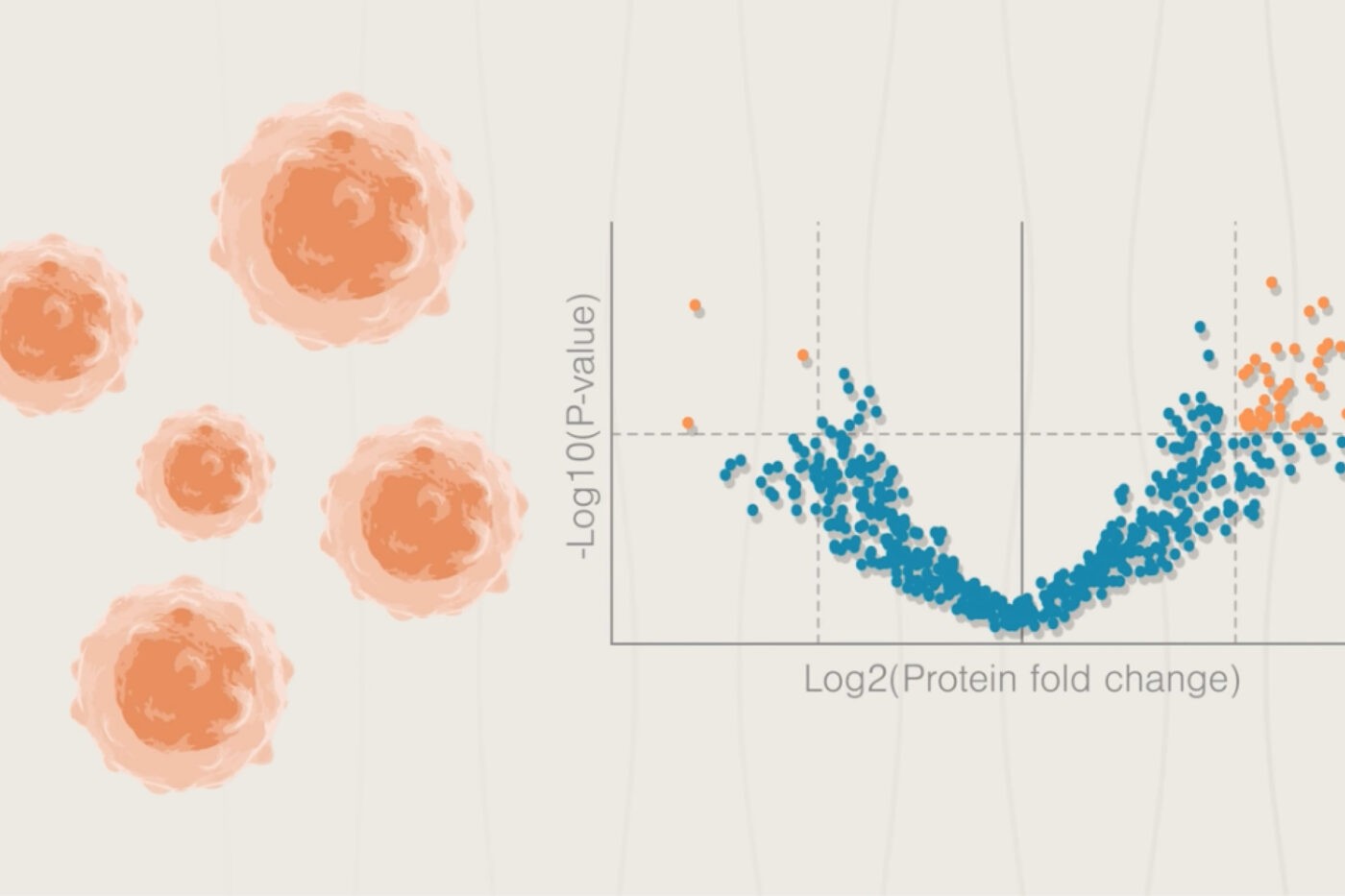
In a more recent publication, Geddes-McAlister’s team analyzed the whole blood proteome to search for diagnostic biomarkers of cryptococcal infection. In this study, her team profiled both host and pathogen during cryptococcal infection in mice, detecting over 3,000 host proteins and 160 fungal proteins. By tracking these proteins over time, the team identified proteome changes during the course of infection that could provide insights into the prognosis of infection. In the future, she hopes this work may identify diagnostic and/or prognostic biomarkers that could then be detected more easily using ELISA in a clinical diagnostic setting. For this work, she mentioned that “proteomics really empowered our research… we wouldn’t be able to find [these markers] with genomics or transcriptomics.”
Proteomics reveals antifungal resistance mechanisms
While genomics is important, genomic signatures are static. The mutations are always there (unless the cell mutates again), but the information encoded in proteins, on the other hand, can constantly change. Geddes-McAlister witnessed this when she examined antifungal resistance in cryptococcus. Researchers often view resistance mechanisms as tied to genetic mutations, but as we can see from Geddes-McAlister’s work, this isn’t always the case. For example, her lab recently compared the proteomes of a fluconazole sensitive strain of C. neoformans, a lab evolved resistant strain, and a clinical isolate that was also resistant. The team identified six proteins that were more highly expressed in clinical isolates and their lab-evolved isolate compared to the sensitive strain. She saw that protein levels change with exposure to the antifungal drug and that she could even turn resistance to the drug on and off by inhibiting the protein. Although the wild type strain and the lab evolved strain had similar genomes, they expressed different proteins – it was their proteomic differences that accounted for differences in antifungal susceptibility.
In addition to capturing information that couldn’t be accounted for by the genome, another key advantage to studying the proteome is that it captures events on multiple timescales. Post translational modifications or cleavage events are very fast, while turnover-mediated events, such as shifts in transcription, and translation, are slower. Studying the proteome at these various levels provides “live” and longer-term views of cellular events.
Improving molecular pharming yields with proteomics
Beyond natural host-microbe interactions, Geddes-McAlister’s work on “molecular pharming” employs a natural plant-bacterial relationship to produce recombinant proteins for human health applications. Unlike traditional methods that use microorganisms to produce the desired protein in bioreactors, molecular pharming doesn’t require the infrastructure that traditional bioprocessing does.
One way to do this is to use a naturally occurring agrobacterium that infects plants. During infection, agrobacteria inject their DNA into plants, causing them to produce proteins that the bacteria need to survive. Scientists can harness this process by giving the agrobacteria DNA encoding a desired protein product (ex: to code for an antibody, biologic, etc.). After infection of the target plants, the scientists collect their leaves and extract the protein.
One of the key challenges in molecular pharming is maximizing the yield of functional, pure proteins. Geddes-McAlister’s work used proteomics to probe the best ways to grow bacteria, to understand what happens during infection, and to determine how to improve yield. In her work using plants to express an antibody (the breast cancer drug trastuzumab), she used a multiomic approach to follow proteomic and metabolomic changes over the course of infection after two different bacterial growth conditions: either in shake flasks or in bioreactors. Plants infected with bioreactor-grown bacteria produced higher trastuzumab yields at earlier time points. This correlated with an increase in ABC transporter proteins as well as other outer membrane and virulence proteins. Her team also identified proteases from the plant that likely degraded the target antibody. In follow-up experiments, knocking down the proteases confirmed the link between yield and protein degradation. A multiomic approach like this one could help improve molecular pharming workflows and in a broader sense, multiomic studies can provide more comprehensive views of biological systems by capturing associated changes between the various omic layers.
The future of proteomics depends on improved accessibility
Proteomics approaches have come a long way since Geddes-McAlister started in the field. But there’s still room for improvement. Geddes-McAlister sees accessibility in instrumentation, such as mass spectrometers, as a barrier especially for early career scientists. She recalled that it wasn’t until her postdoc years that she was able to operate a mass spectrometer. Another current gap in proteomics research is that many parts of the entire proteomics pipeline are siloed. She cited drug discovery as an example where the use of computational methods to predict or design drugs is separate from the synthesis and production of these molecules. In an ideal world, an automated system could handle the entire pipeline.
At Nautilus, we’re excited that the Nautilus™ Proteome Analysis Platform is designed to bridge this accessibility gap by streamlining sample preparation and implementing a hands-off analysis workflow. Furthermore, we aim to deliver digital, single-molecule counts of protein quantity designed to help scientists quickly achieve novel biological insights.
MORE ARTICLES