
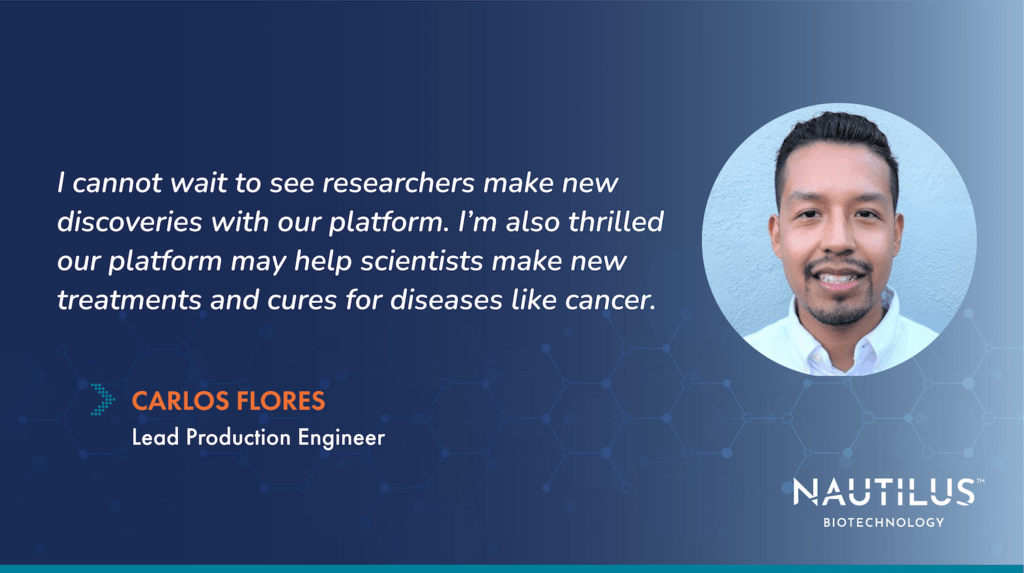
Carlos Flores is a Lead Production Engineer at Nautilus. He ensures the quality and timely production of the flow cells we use to immobilize billions of protein molecules for single-molecule analysis via Iterative Mapping.
As a member of the Operations Team, Carlos essentially works at a company-within-a-company, where Nautilus is the sole customer. He and his team are tasked with ensuring Nautilus R&D staff have all the materials, consumables, and reagents they need to process customer samples, conduct internal research, and reach development goals.
In the interview below, you’ll learn why, as a very hands-on engineer, Carlos excels in his operations role, and you’ll also discover some of the crucial things Carlos has learned in his time at Nautilus.
What got you interested in engineering?
I didn’t have a particular interest in pursuing a science or engineering career until my senior year of high school. Before that time, most of my science education was focused on the life sciences and involved a lot of memorization. Thankfully, I had an awesome chemistry teacher in my senior year, and he got way more hands-on than my previous teachers. For instance, I remember one demonstration where he lit various chemicals on fire and explained why the flames were different colors. Looking back at my childhood, I always liked to do hands-on things like build computers, but it wasn’t until this chemistry class that I realized science could be hands-on too.
Following graduation, I entered San Jose State with the chemistry bug and majored in Chemical Engineering. There I got to take classes in agricultural engineering, renewable energy, and biotech. Both renewables and biotech were super interesting to me thanks to their potential for positive impact, and after college I got a job in operations at Thermo Fisher. It was very cool to see how regimented their production processes were, and it was great to be a part of their team. Yet, I found that I wanted to be one of the people establishing production processes as opposed to only implementing them.
How did you get your start at Nautilus and what do you do day-to-day?
A friend of mine was working at Nautilus and pitched me to join the team. Nautilus sounded like the dream place to work because:
- Nautilus needed team members who could help build systems and processes.
- Nautilus was and is doing something entirely new.
- It was clear that the Nautilus Platform could have huge, positive impacts on the life sciences and healthcare.
I was overjoyed to be hired after applying for a position on the operations team. During my nearly 4 years here, I’ve gotten to work with a ton of great people and on a variety of cross-functional projects including:
- Developing processes that supply R&D while staying within the bounds of a tight budget.
- Forecasting future costs and needs for ever-evolving production processes.
- Maintaining an exemplary level of quality despite evolving needs .
On a day-to-day basis, I usually start my day checking inventories and making sure everyone is stocked up on the items they need. Then, I have meetings where we scope out R&D needs and report to the finance team. Later, I take part in production processes – I might help build and maintain flow cells or prepare various reagents for R&D teams. Finally, I make sure all the materials we produce get to the researchers who need them. It’s a lot of moving parts, and we must be attentive to the needs of finance, R&D, and others at the company. At the same time, we must always be on the lookout for ways to update our processes and make them more efficient.
What are some of the key things you’ve learned at Nautilus, and what do you hope to do in the future?
In my role at Nautilus, I work across operations, finance, and R&D to make sure everyone gets the supplies they need to do their jobs as efficiently as possible. Along the way, I’ve learned a variety of things that I know will be important throughout my career. A few of the most salient include:
- Over-communication is key – Working in a fast-paced environment, people are learning new things all the time, and it can be hard to keep track of who is caught up on what. Taking care to be as thorough and clear as possible helps. Even if you’re repeating information to some people, they’ll probably appreciate the reminder.
- It’s important to know when you can make a call – As a junior employee, you often ask your manager if you can move forward, but as you progress, it’s important to figure out when you can make calls on your own. Taking ownership and making decisions with the support of supervisors who trust you can make processes move much more smoothly and efficiently.
- Do what you’re passionate about – I’m passionate about building things and pattern recognition. I didn’t really realize that or at least didn’t see value in it before coming to Nautilus, but I’ve noticed that people who are passionate about their work are often the most successful. I’m excited to lean into my passions even more as my career progresses.
In my future at Nautilus, I’m excited to put these learnings to work as we develop processes for efficient, high-quality analysis of customer samples. I cannot wait to see researchers make new discoveries with our platform. I’m also thrilled our platform may help scientists make new treatments and cures for diseases like cancer.
Eventually, I hope to put everything I’ve learned at Nautilus to work starting my own business. Though I don’t know what form it will take yet, I’m particularly keen on doing something that will have a direct positive impact on my community in the Bay Area. I already do a lot of service projects outside of work, but I hope to build something that can help small business owners – everything I’ve learned at Nautilus will be invaluable for that.
MORE ARTICLES