
Introducing the Iterative Mapping Grant Program

Nautilus Biotechnology
July 16, 2026
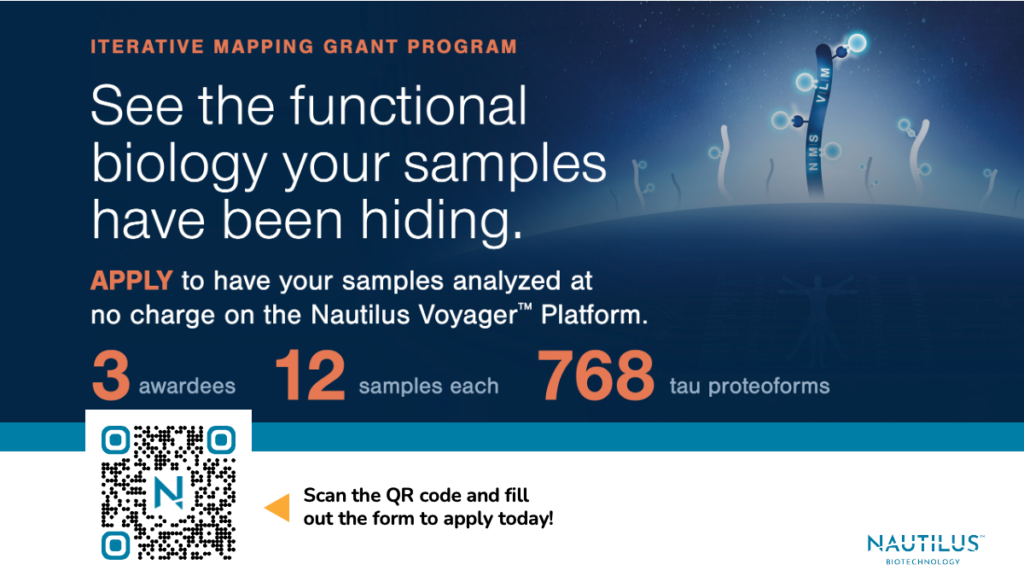
Tau proteoforms may hold the key to understanding neurodegenerative disease progress, but until now, no platform could quantify them at scale. The Iterative Mapping Grant Program provides researchers with free access to the Nautilus Tau Proteoforms Assay. The assay quantifies up to 768 full-length tau proteoforms at the single-molecule level on the Nautilus Voyager™ Platform.
Through the Iterative Mapping Grant program, 3 researchers will be selected to join the Iterative Mapping Early Access Program at no charge. Each will receive analysis of 12 samples, experimental design support from Nautilus scientists, a final data report built for easy interpretation, help presenting results at a mutually agreed-upon conference, and assistance preparing a peer-reviewed publication.
We provide brief details on the program below and encourage you to visit the program webpage for more information as well as the program’s full terms and conditions.
Download the Iterative Mapping Early Access Program Brochure for more information on the Nautilus Tau Proteoforms Assay.
How to apply to the Iterative Mapping Grant Program
To apply, submit a proposal for a 12-sample project on the grant program webpage by July 31, 2026, with samples ready to ship by November 30, 2026. Applicants must also be willing to be publicly announced as grant recipients and to let Nautilus reference their work in future marketing materials. Sample sources and types must match the specifications listed on the grant program webpage, so be sure to check there before submitting.
Iterative Mapping Grant Program project ideas
Not sure what to propose? Find some brief ideas that might make good seeds for grants below. We have a few additional ideas on the grant program website and encourage you to reach out to marketing@nautlus.bio if you have any questions about potential projects.
- Differentiating tauopathies by their distinct tau proteoform profiles. This could sharpen diagnostic tools across diseases.
- Identifying which tau proteoforms are most likely to seed aggregation or spread between neurons. Identifying these proteoforms may be central to understanding disease progression.
- Exploring which tau proteoforms are associated with known disease risk variants. Such explorations may reveal the mechanistic links between genetic risk and disease development.
Visit the Iterative Mapping Grant Program webpage for more information as well as the program’s full terms and conditions. Winners will be announced on or before August 14, 2026. Good luck!
MORE ARTICLES