
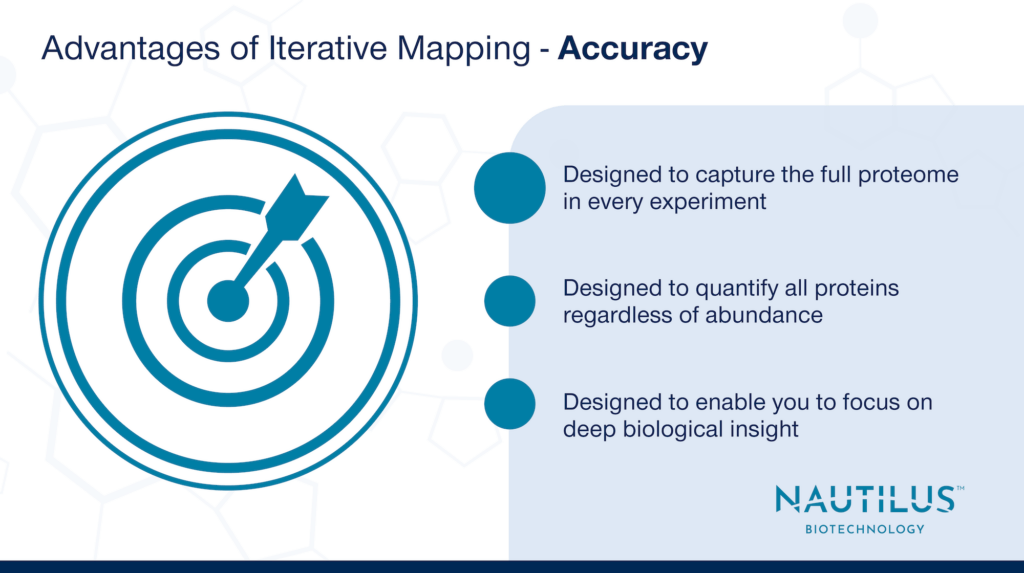
An accurate quantification method consistently and correctly reports the quantity of an analyte. In proteomics, accuracy comes in the form of correctly quantifying proteins and proteoforms across the full proteome. Nautilus’ method for single-molecule proteomic analysis, Iterative Mapping, is designed to achieve high accuracy thanks to:
Comprehensive proteome capture
Iterative Mapping is designed to quantify all the proteins in the proteome in every experiment. In the method, single protein molecules are captured on massive arrays, identified, and counted. These arrays are nanoengineered to accommodate 10-billion proteins and are thus designed to capture substantively every protein in the proteome without leaving high or low abundance proteins behind.
If you don’t comprehensively capture the proteome with a proteomic analysis method, you will not be able to accurately measure the abundance of all the proteins it contains. Indeed, if you can only analyze small fractions of the proteome in any given experiment, you might quantify different fractions in every experiment and therefore get variable and erroneous abundance measurements. Furthermore, it is likely that high abundance proteins will be over-represented in your data while the low abundance proteins will be left out.
Single-molecule quantification through repeated probing
Iterative Mapping is a single-molecule method where every individual protein molecule captured is analyzed independently. As long as a protein is captured, Iterative Mapping is designed to be able to identify it regardless of how many times it appears on one of our protein arrays. In addition, we aim to identify every molecule through many probe-binding events that combine to provide high confidence in those identifications. Molecules identified as the same protein or proteoform are then counted for quantification meaning the method can theoretically quantify down to single molecules. In practice, even a single-molecule assay will have some noise that obscures single-molecule quantifications, but in our recent preprint, we demonstrate that Iterative Mapping practically achieves quantification of tau proteoforms down to 0.1% relative abundance. In that same preprint, we also measured the tau proteoform assay’s mean absolute percent error at <10%.
Even if other methods do capture all the proteins in the proteome, they may not be able to detect or quantify those at low abundance. Most of these methods measure proteins in bulk and blur together signals coming from many proteins. As a result, signals coming from high-abundance proteins often drown out those from low abundance proteins, and low abundance proteins cannot be measured accurately.
Biological insights driven by accurate quantification
Iterative Mapping has the potential to provide the most accurate views of the proteome possible. It is designed for comprehensive proteome capture, confident identification of single molecules, and simple quantification through counting. Ultimately, we hope researchers will use Iterative Mapping to quantify the proteins, proteoforms, and protein networks driving biological processes. With this knowledge in hand, we aim for them to have the information and tools needed to identify next-generation biomarkers and to develop novel precision medicines.
Learn how you can incorporate Iterative Mapping into your workflows.
MORE ARTICLES