Advantages of Iterative Mapping – Standardization and scalability

Tyler Ford
January 14, 2026
Scalability is critical in proteomics—it enables full proteome quantification and repeatable analyses across samples and labs. Standardization makes this possible: when every protein can be analyzed in the same way using similar reagents, processes, and instruments, workflows become scalable. But proteins vary widely in size, charge, and chemistry, making standardization challenging for most proteomics methods. This post explores how Nautilus’ novel Iterative Mapping method is designed to overcome these challenges to deliver a standardized and scalable approach with the potential to enable full proteome coverage in any lab.
Nanoparticle scaffolding and single-molecule protein capture
The proteome contains thousands of proteins and potentially millions of proteoforms with diverse chemical properties. This heterogeneity makes parallel analysis difficult, limiting the throughput and coverage achievable with most proteomics methods.
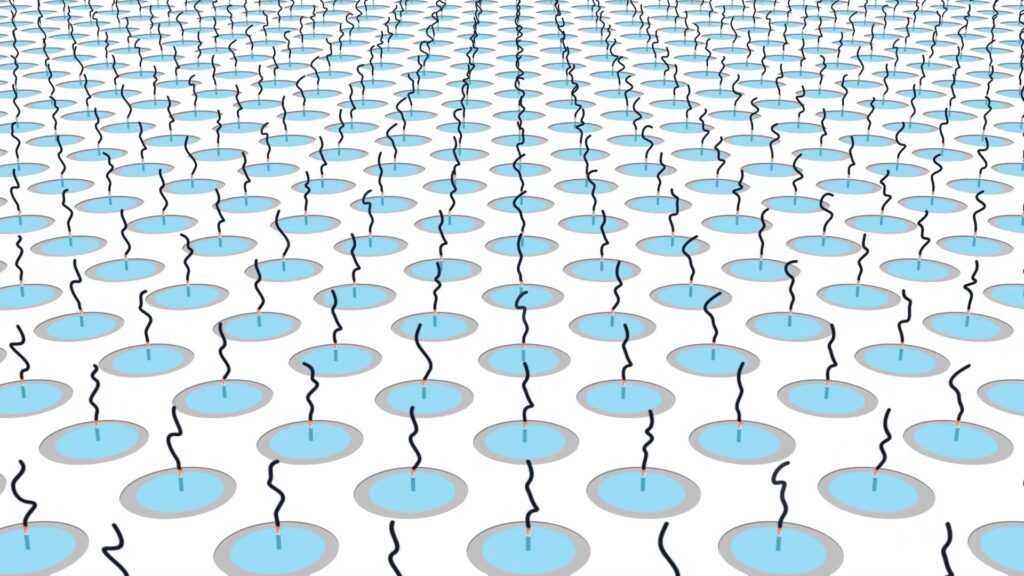
In Iterative Mapping, we aim to overcome this issue by conjugating every protein molecule analyzed to its own DNA nanoparticle. These nanoparticles are far larger than the proteins they scaffold, and each has only one protein attachment site. By conjugating every protein molecule in a sample to a scaffold, we create protein-scaffold conjugates that are roughly uniformin size and which all have the same nanoparticle chemical properties.
Then, through engineered interactions between the nanoparticles and “landing pads” etched into our flow cells, we create massive, ordered arrays of single-protein molecules that are optically distinguishable. We thus take the cacophony of proteins in the proteome and arrange them on our arrays so they can all be analyzed massively in parallel using Iterative Mapping.
Read our tech note to learn more about how we make our hyper-dense protein arrays.
Iterative Mapping underlies analyses of all proteins and proteoforms on the Nautilus VoyagerTM Platform
Instead of custom reagents and parameters for every protein and proteoform, Nautilus uses Iterative Mapping—a single, standardized method for all experiments. In this technique, fluorescent probes designed to bind pre-defined protein features are flowed over our single-molecule protein arrays. A probe-protein binding event is recorded whenever fluorescence localizes to one of the billions of single protein molecules.
All broadscale proteomic analyses employing Iterative Mapping are designed to use the same set of probes detecting 3 amino acid sequences. We estimate that just 300 of these probes are needed to identify substantively every protein regardless of abundance because all probe-protein binding events are independent. Protein identifications are then summed for highly accurate and reproducible single-molecule quantification.
Similarly, for proteoform analysis, Iterative Mapping uses probes binding proteoform features such as modifications or splice sites. Importantly, Iterative Mapping does not need new probes for every proteoform. Instead, the method simply analyzes which combinations of binding events localize to each protein molecule – sets of binding events localized to single protein molecules identify combinations of features that define proteoform identity. With as few as 10 probes, this technique could identify over 1,000 proteoforms thanks to its combinatorial nature. Akin to broadscale analyses, molecules identified as the same proteoform are summed for highly accurate and reproducible single-molecule quantification.
Overall, with Iterative Mapping, we aim for there to be no need to optimize assay parameters for each protein and proteoform – it’s the same Iterative Mapping method for every proteome and proteoform family.
Watch this animation to see how Iterative Mapping is used to quantify proteins and proteoforms on the Nautilus Voyager Platform:
Digital counts of proteins and proteoforms
After identification, Iterative Mapping sums identical proteins or proteoforms for quantification and is designed to deliver clear, digital counts that are easy to compare. Thus, Iterative Mapping is also designed to be scalable because we aim for any lab to be able to analyze the simple data it generates. These easy-to-understand protein and proteoform counts should also be easy to integrate into downstream multiomic and AI-powered workflows.
Standardization and scalability delivered to every lab
From preparation to output, Iterative Mapping is designed to be fully standardized for massive parallelization—making it potentially scalable across proteomes, samples, and labs. Ultimately, we hope this standardization and scalability will make Iterative Mapping accessible to any scientist who wishes to use it, and we hope you’ll reach out to learn more about incorporating Iterative Mapping into your workflows.
MORE ARTICLES