
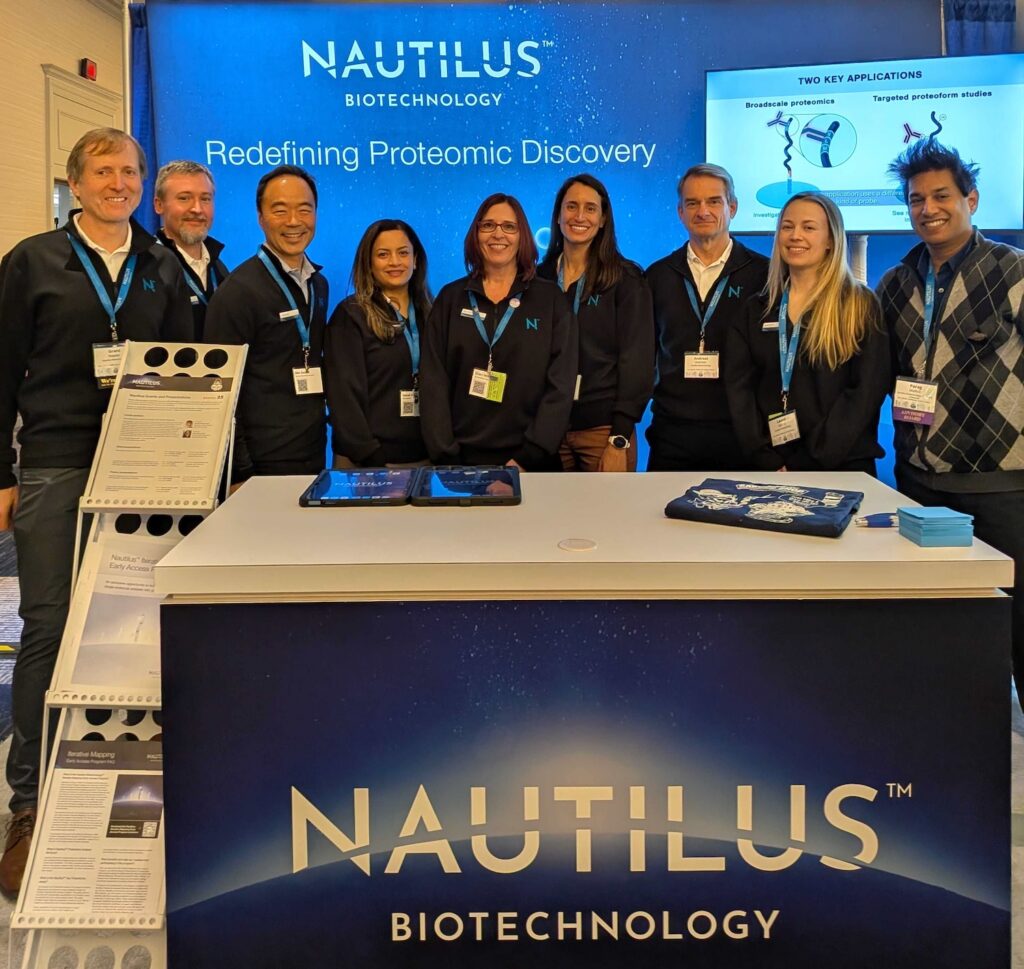
US HUPO 2026 was full of revelations from the Nautilus Team. In her lighting talk, Nautilus VP of Scientific Engagement, Sheri Wilcox shared some of the most exciting ones:
- First, she pulled off a blue wig revealing that she was not Nautilus Co-Founder and Chief Scientist Parag Mallick.
- Next, she briefly highlighted some of the fascinating and novel single-molecule data already being generated on the Nautilus Voyager Platform.
- And finally, she hinted at the fact that we would be revealing the Nautilus VoyagerTM Platform at an exclusive event later in the evening.
In this blog post, we explore the latter two of these important revelations and invite you to be one of the first to use the Nautilus Voyager Platform through our Iterative Mapping Early Access Program. By joining the Early Access Program, you’ll have the unique opportunity to reveal currently hidden but essential swaths of the proteomic landscape that drive your biological process of interest.
Novel data generated on the Nautilus VoyagerTM Platform
We shared novel data generated on the Nautilus Voyager Platform at our oral presentations, at our posters, and during our lunch seminar featuring Birgit Schilling Ph.D., Professor and Director of the Mass Spectrometry Core at the Buck Institute for Research on Aging. You can access a summary of all the data we presented at US HUPO 2026 by filling out the form here. Below we highlight just a small fraction of the data generated by the Schilling and Ellerby Labs at the Buck Institute where they already have a Voyager instrument on-site!
Previously, we showed that the Voyager Platform generates highly reproducible quantifications of tau proteoforms, and during a recent webinar, Birgit shared how the Nautilus Tau Proteoforms assay is already revealing the diversity of tau proteoforms across brain regions in mouse models of aging. At US HUPO 2026, Birgit shared new data generated in collaboration with Professor Lisa Ellerby’s Lab at the Buck Institute showing that iPSC-derived neurons with genotypes conferring varying levels of susceptibility to Alzheimer’s disease have statistically significant differences in the quantities of tau proteoforms. These differences were not observed at the isoform or phosphosite occupancy levels which are what most proteomics technologies measure. In other words, the Voyager Platform provided unique insights into the proteomes of cells with genotypes conferring Alzheimer’s susceptibility.
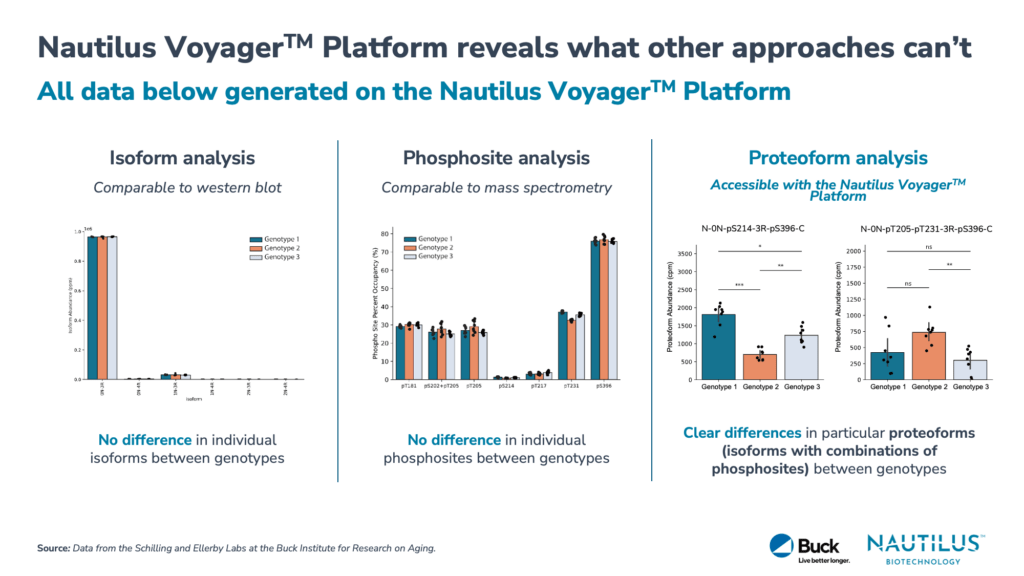
This data is very new, but also very exciting. It provides initial clues that differences in tau proteoforms and not isoforms or phosphosite occupancies may underly the phenotypic differences conferred by these genotypes. That is, proteoform-level differences may be driving biology. This is something we at Nautilus suspect is true for most biological processes, but these results are a strong data point for the argument that researchers should be studying proteins at the proteoform level. Some of the Alzheimer’s-associated tau proteoforms identified in this work may eventually become new biomarkers or drug targets. It is the large-scale single-molecule analysis enabled by Iterative Mapping on the Nautilus Voyager Platform that makes further exploration of these proteoforms possible!
Access a recording of our US HUPO 2026 Lunch Seminar Featuring Professor Birgit Schililng here.
Additional data from our work with the Allen Institute for Brain Science is also beginning to hint that particular tau proteoform profiles are associated with Alzheimer’s disease – this preliminary data can be found in our US HUPO 2026 data summary, and we cannot wait to dive into it further in future work.
Revealing the Nautilus VoyagerTM Platform

This is the first blog post where we’ve used the words “Nautilus Voyager Platform.” The reason? We revealed the platform at US HUPO 2026! At an after-hours event, we shared that we had a demo unit on-site and invited members of the US HUPO community to see the demo unit themselves. You can find a video featuring the Voyager Platform as well as descriptions of its components at Nautilus.bio/voyager-platform.
Briefly, the Nautilus Voyager Platform consists of integrated reagents, fluidics, imaging, and ultra-dense nano-array flow cells enabling Iterative Mapping and cloud-based analysis of single-molecule data outputs. It is designed to occupy a typical lab benchtop with standard facility requirements – no bespoke gas or fluidic connections needed.
To be one of the first researchers to use the Nautilus Voyager Platform and generate single-molecule proteomic data like that shared by Birgit Schilling, we strongly encourage you to join the Iterative Mapping Early Access program. Our first offering through the program is the Nautilus Tau Proteoforms assay, and we will be building additional capabilities over the course of the year – we would love for you to submit a project even if it does not involve tau. Some participants in the Iterative Mapping Early Access Program may even have Nautilus Voyager Platforms installed in their labs!
Nautilus Team Members react to the reception of the VoyagerTM Platform
Nautilus Team members were invigorated by the community’s palpable excitement upon seeing the Voyager Platform for the first time. Some takeaways from Nautilus Team members can be found below.
- Sheri Wilcox, Vice President of Scientific Engagement
People were pleasantly surprised when they learned the Voyager Platform runs on a regular-old outlet plus ethernet. It was very satisfying for people to snap a flow cell into place and feel it seat properly. Generally, the sense was, “Wow, you really did it!” after someone was able to see and touch it themselves. - Jamie Kuhar, Head of Product Management
People were very impressed with the Voyager Platform and thrilled to see it come to life. There was such enthusiasm for what Iterative Mapping can deliver in the short and long term and seeing the Voyager Platform made it that much more tangible. The unveiling spurred great conversations that will help us ensure we’re delivering what our customers need! - Jonathan Menger, Associate Director of Design Engineering
I loved watching everyone’s reactions when they tried the instrument for the first time and walked through the workflow. They found it simple, intuitive, and impressive – the reactions consistently were: “So good to see it’s finally here!” - Sonal Tonapi, Associate Director, Proteomics Analysis Services
People were eager to engage with the instrument directly. While loading the flow cells and reagents themselves, they were struck by how intuitive and easy the workflow felt. Right after a demo, an attendee simply said, “It’s beautiful!” That excitement only grew when they saw the data and started discussions on how Iterative Mapping will help them get meaningful insights into their research questions.
Revealing the proteomic landscape
Everyone at Nautilus is proud that the Nautilus Voyager Platform is already beginning to reveal hidden portions of the proteomic landscape. Our interactions with the community at US HUPO 2026 made it clear that proteomics researchers are equally excited to incorporate large-scale, single-molecule proteomics into their workflows. With excellent questions at our lunch seminar, a full day of Voyager Platform demos, and deep conversations about future projects, we are confident that many new discoveries will soon be achieved through the power of Iterative Mapping on the Voyager Platform. Don’t miss your opportunity to be one of the first to join us as we explore the proteome with unprecedented single-molecule detail.
MORE ARTICLES